
NICKE STUDIO / AI and critical thinking
AI and critical thinking: does it make you smarter?
Does AI make you smarter? Explore studies on productivity, learning and critical thinking, with verified statistics and practical B2B and B2C workflows.

Does AI make you smarter, or does it make thinking for yourself easier to avoid? That question matters when you write a campaign, learn an unfamiliar tool or need to make a decision. A response delivered in seconds can be valuable. It can also leave you feeling that you understand something you could not yet explain independently.
Research does not establish that using artificial intelligence automatically increases or reduces intelligence. It does reveal differences between finishing a task, learning how to do it and remaining able to check the result. Those distinctions have practical consequences for marketing teams, B2B businesses and B2C brands.
This review brings together five studies from 2023–2026. Their percentages describe particular tasks and participants. None of the findings presented here is a measured change in IQ.
Delivering a better answer does not guarantee that you have learned to build it.
Separate productivity, learning and intelligence
Productivity concerns the results achieved with available time and resources. Learning involves being able to explain or apply something later. Critical thinking includes evaluating evidence, identifying assumptions and justifying a decision. These abilities are related, but they are not interchangeable measurements.
Someone can write faster with AI while practising argument construction less. Another person can use the same assistant to investigate objections and understand a problem more deeply. Counting completed documents does not distinguish those experiences.
Before accepting an AI headline, ask what was measured: writing quality, an exercise score, participants’ opinions or performance without assistance? That question prevents a limited finding from becoming an unsupported claim about the whole population.
What five studies actually measured
| Study and setting | Observed finding | How to read it |
|---|---|---|
| Noy and Zhang, Science, 2023; 453 professionals | 40% less time and 18% higher quality on writing tasks | Assisted performance, not an intelligence increase |
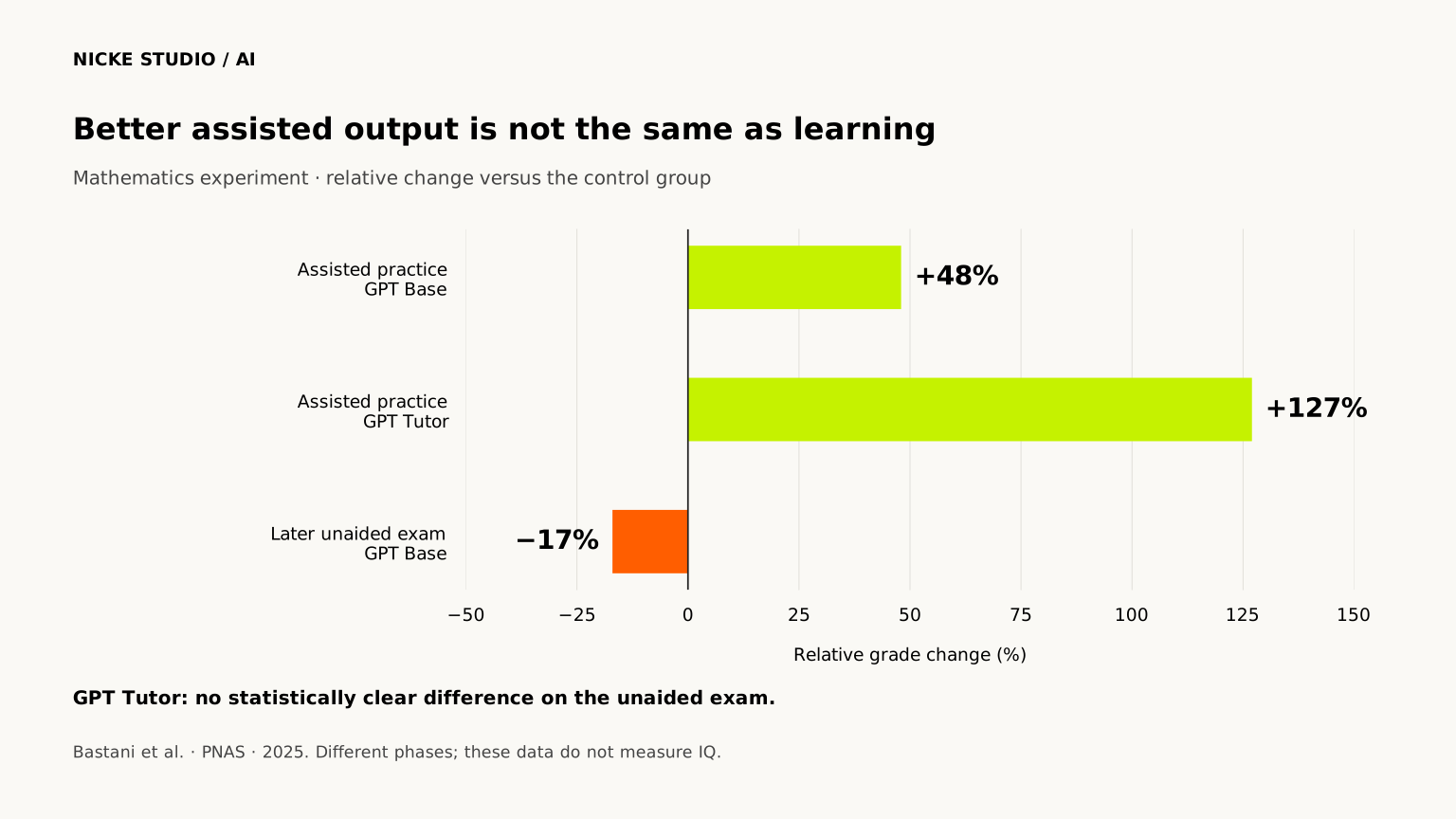
| Bastani and colleagues, PNAS, 2025; nearly 1,000 students | Practice: +48% with GPT Base and +127% with GPT Tutor; later unaided exam: −17% for GPT Base | Outcomes changed after assistance was removed |
| Physics tutoring, Scientific Reports, 2025; 194 students | Median learning gains more than doubled compared with the classroom condition | A designed tutor for particular lessons |
| Lee and colleagues, CHI, 2025; 319 workers and 936 examples | Higher confidence in AI was associated with less reported critical thinking | A survey, not evidence of causation |
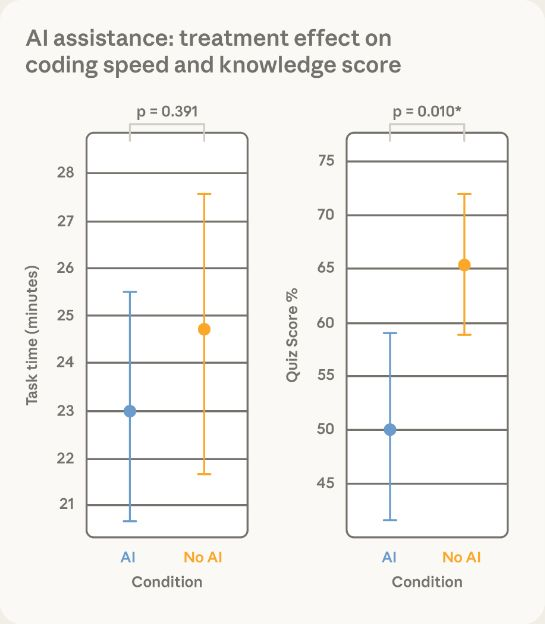
| Shen and Tamkin, 2026 preprint; 52 programmers | Lower immediate comprehension with assistance; time difference not significant | A small experiment involving a new skill |
The methods and outcome measures differ. This table compares research questions; it cannot produce an average “effect of AI on the brain”.
Better writing with AI does not establish greater knowledge
The Noy and Zhang experiment published in Science assigned professional writing tasks and randomly gave some participants access to ChatGPT. It found improvements in completion time and assessed quality. That provides a concrete reason to explore assistants for drafts, proposals and routine communication.
Calling those participants 18% more intelligent would go beyond the result: the experiment assessed written outputs. In marketing, examine the finished text, the accuracy of its claims and the full editing time. A fast draft still needs judgment about its audience, the offer and the evidence supporting it.
A B2B sales argument must survive questions about scope and implementation. A B2C product promise needs to match what the customer actually receives. Fluent wording does not verify either requirement.
The risk of delegating the practice itself
The mathematics trial by Bastani and colleagues separated assisted practice from a subsequent exam without resources. GPT Base improved practice performance, yet its group performed worse later without help. The safeguarded tutor mitigated that disadvantage; it did not show a clear benefit on the independent exam.
The −17% describes a relative reduction against the comparison group, not 17 IQ points or proof of permanent harm. The following chart is our own presentation of published findings, rather than a screenshot from the journal. It identifies the separate phases so that assistance is not mistaken for learning.
The useful interpretation is that receiving a solution can replace some of the work through which a skill develops. That does not require refusing assistance. It requires deciding which parts you need to practise and which you can delegate while preserving understanding.
A carefully designed tutor can also support learning
The physics study in Scientific Reports provides a counterpoint. In that trial with Harvard students, an AI tutor designed around pedagogical principles produced greater learning gains than the active-learning classroom condition. Median learning gains were more than twice as large for the lessons studied.
This does not establish that any chatbot can replace a teacher. It shows why “using AI” describes different experiences. A tool that offers gradual hints, requests an attempt and provides feedback creates a different learning task from one that supplies an answer ready to copy.
When learning a marketing tool, ask the assistant to critique your explanation or propose an unfamiliar example. Keep opportunities to make mistakes, correct them and apply the idea in your own words.
The 2026 experiment and the skill of supervision
Shen and Tamkin investigated coding skill formation while participants learned an unfamiliar Python library. The main study involved 52 people. Subsequent comprehension was lower with assistance, and the time difference was not statistically significant. It is a preprint, rather than a definitive finding about every professional.
The screenshot preserves the charts, scales and uncertainty bars from Anthropic’s original publication. The findings concern that exercise. The interaction patterns discussed by the authors are exploratory; they do not independently establish that a particular prompting style caused better learning.
For a business, the practical question is who will recognise an incorrect answer after a task is automated. That ability requires training, examples and review. Giving someone the title of supervisor does not automatically create the expertise needed to supervise.
Confidence and critical thinking are different
The Lee and colleagues research presented at CHI 2025 collected 936 examples from 319 knowledge workers. Greater confidence in AI was associated with less self-reported critical thinking. As a survey, it cannot demonstrate that the tool caused a loss of ability.
Turn that limitation into a useful working habit: replace “this sounds convincing” with questions you can investigate. Where did the number come from? Which assumption is missing? What evidence challenges the recommendation? Check that references exist and support the statements attached to them. Asking an assistant for a bibliography does not complete that verification.
How to use AI while keeping your judgment active
Try a straightforward process. This is a proposed working method, not a clinical intervention or a guarantee of learning:
- Make an initial attempt. Write down the problem, your criteria and a short explanation before consulting the assistant.
- Request specific criticism. Ask for weak assumptions, missing information or a reasoned alternative.
- Verify the claims. Open sources, check dates and cross-check consequential details.
- Explain the decision without the chat. Describe why you chose an option and when it might fail.
- Check transfer. Attempt a similar problem with new information and notice where you still need help.

Automate repetitive work and protect attention for the decisions you will need to defend.
In an agency, keep the reasoning beside the deliverable. Record what was checked, what changed and what remains unresolved. Another team member should be able to continue the project without reconstructing a long conversation with an assistant.
Applications for B2B and B2C marketing
| Task | Useful contribution from AI | Human responsibility |
|---|---|---|
| B2B proposal | Organise questions and alternatives | Confirm scope, cost and feasibility |
| B2C campaign | Explore message approaches | Verify promises, tone and product details |
| SEO research | Group hypotheses and searches | Validate intent, sources and priorities |
| Performance report | Draft an explanatory structure | Check calculations, attribution and conclusions |
| Team learning | Generate exercises and objections | Assess comprehension without assistance |
These are proposed applications, not measured outcomes from the cited studies. They can connect with our automation and content services and a technical SEO review. The tool needs to fit a real process with someone able to approve or reject its output.
For a pilot, track total time, corrections, final quality and the team’s ability to explain its work. Include verification time: hiding it creates an appearance of productivity. Compare similar tasks and record changes in tool or difficulty before attributing an improvement to AI. Avoid rewarding output volume while overlooking unsupported claims or additional work passed to colleagues.
Work with AI and a clear direction
The evidence supports a cautious conclusion. AI can expand what you achieve with assistance, and certain uses can reduce the practice through which learning develops. Outcomes depend on the tool’s design, the task and the way people participate. These studies do not resolve long-term effects on general intelligence.
Nicke Studio connects automation, web development, technical SEO and content production with human review and defined goals. We can help you identify what to automate, what to verify and how to document a workflow your team can maintain.
Tell us about your project, and we can examine a concrete process. The aim is to put AI to work through useful deliverables and decisions you can understand, verify and improve.
Sources and scope
- Noy and Zhang, Science, 2023: professional writing experiment.
- Bastani and colleagues, PNAS, 2025: mathematics practice and learning.
- Scientific Reports, 2025: AI tutoring and active learning in physics.
- Lee and colleagues, CHI, 2025: critical-thinking survey.
- Shen and Tamkin, 2026: skill-formation preprint.
Editorial review: 29 October 2026. Selected research, not a systematic review. The illustrations were generated for Nicke Studio and are identified separately from our data chart and the original-source screenshot.