
NICKE STUDIO / Working with AI
Geminis AI: how Gemini and Antigravity expanded what I can build · Nordics
My experience building this website with AI: Gemini, Antigravity IDE and a current comparison of costs with GPT and Claude. Nordics.


Official Google brand assets. Gemini · Antigravity
Read in another language ↗
If you searched for Geminis AI, the official product name is Google Gemini. Behind that small spelling difference is a bigger question: what changes when a curious creative professional can develop a website with AI? For me, the answer is visible here. You are reading an article on a website whose direction, content and development decisions I can take responsibility for, despite having no traditional education in programming.
My starting point was creativity and curiosity
I am Nickenson Hurtado, the person behind Nicke Studio, working from Caracas. My background includes design, video, sound and practical technical problem solving. Those experiences taught me to recognize an awkward composition, an unclear message or a process with unnecessary steps.
Programming used to add a considerable distance between an idea and something I could test. AI has shortened that distance. I can explain the experience I want, inspect a proposal, ask why a change is necessary and evaluate the result in context. The professional growth feels faster because learning and production happen together.
This website makes that change tangible. A useful article also needs a readable page, working navigation, appropriate imagery and an accessible experience on a phone. I remain responsible for those choices. Gemini is part of a wider shift that lets people with judgment and curiosity participate much more directly in building their own tools.
Where Gemini ends and Antigravity begins
Three things are worth distinguishing. Gemini is Google's model family. The Gemini app provides a conversational experience. Google Antigravity is a development environment that gives AI agents access to a project and tools for carrying work forward.
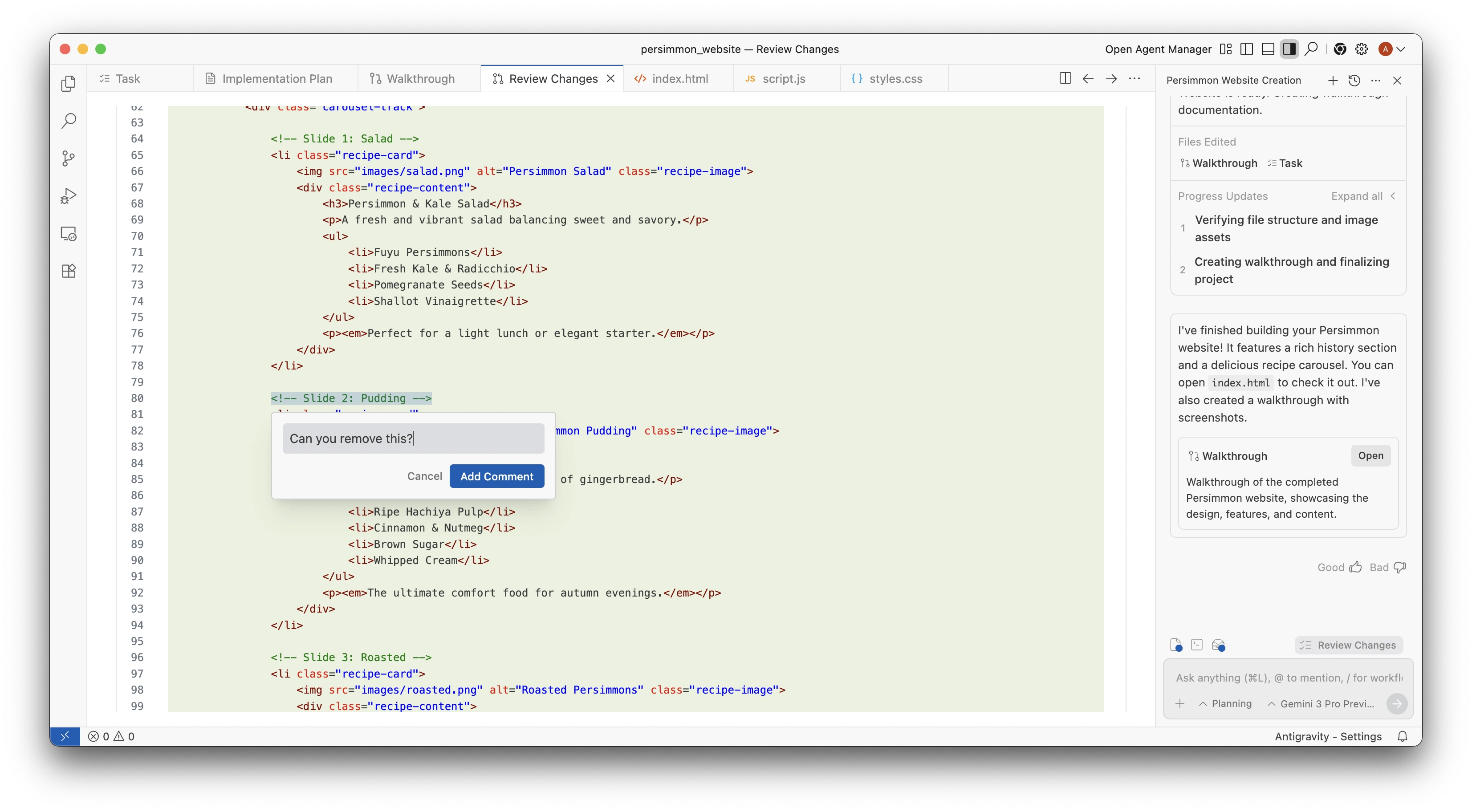
Google introduced Antigravity in November 2025 with an IDE, an agent management interface and interactions spanning the editor, terminal and browser. Its launch explanation describes plans, task lists and walkthroughs that make agent work easier to inspect.
The platform has since expanded across its app, IDE and command line. Its current model documentation lists Gemini 3.8 Flash, Gemini 4 Argon and eligible Claude models, with access depending on the plan.
The impact is a shorter path to useful work
The important improvement for a small studio is the ability to move through an entire task: understand a requirement, prepare changes, inspect a page and correct what fails. Generating a fragment of code is only one part of that journey.
There is evidence of adoption at a much larger scale. In its 13 October 2026 Antigravity announcement, Google reported more than 100,000 monthly users across Alphabet, a 35% increase in agentic code over four weeks and a 30% reduction in post-submit rollbacks. These are Google's internal findings. They describe its environment and measurement, rather than predicting my results or any reader's return on investment.
How I approach an AI-assisted website
I start with the visitor and the purpose of the page. Who is reading? What do they need to understand? What action should become easier? Clear answers give the agent a better brief and give me a standard for reviewing its work.
Then I ask for a plan, with the relevant files and the expected behaviour. A focused change is easier to evaluate than a vague request to improve everything. After implementation, I inspect the layout, links, text and images at different screen sizes. A page that looks complete can still send someone to the wrong language or hide the contact button.
I ask the AI to explain unfamiliar decisions, retain a version I can return to and approve publication after checking the result. Documentation helps another professional understand the project later.
Faster growth requires active learning
My progress improves when I ask questions that make knowledge reusable. Why did this layout break on mobile? Which file controls this component? What would verify that the correction worked? Understanding those answers makes the next request more precise.
My creative experience helps me judge hierarchy, rhythm and clarity. AI connects that judgment to implementation and gives me opportunities to learn while making something useful.
That is the professional benefit I value most: a wider range of problems I can investigate and resolve. Any model that supports that process can contribute. The name on the subscription matters less than the quality of the work I can explain and maintain.
Comparing current models without choosing a universal winner
The following comparison uses standard, uncached text API prices in USD per million tokens, checked on 29 October 2026. The final column is a hypothetical task with 100,000 input tokens and 20,000 output tokens.
| Model | Input / 1M | Output / 1M | Example task |
|---|---|---|---|
| Gemini 3.8 Flash | $0.75 | $3.75 | $0.15 |
| Gemini 4 Argon | $2.00 | $10.00 | $0.40 |
| GPT-6.1 Sol | $2.00 | $10.00 | $0.40 |
| Claude Sonnet 5.5 | $2.00 | $10.00 | $0.40 |
| Claude Opus 5.5 | $4.00 | $20.00 | $0.80 |
Google's prices for Flash are introductory through 31 December 2026, then $1.50/$7.50; Argon's apply through 30 November, then $4/$20. GPT-6.1 Sol has higher API rates above 272,000 input tokens. Sonnet and Opus rates come from Anthropic. The examples exclude caching, tools, retries and taxes.
Flash is a reasonable starting point to test repeated, bounded work. Argon, Sol and the Claude models deserve evaluation on harder tasks. Equal token counts do not establish equal quality or completion rates. GPT-6.1 Sol is an external comparison here, rather than a claimed native Antigravity option.
Cost and benefit belong to the whole project
A monthly subscription and an API invoice purchase different kinds of access. Antigravity's plans and quotas determine available usage; API rates describe metered consumption.
I also count briefing, review, failed attempts, maintenance and the time another person needs to understand the result. A cheaper model can become expensive if it repeatedly produces changes I must undo. A stronger model can justify its cost when it resolves a difficult problem with less supervision.
For my professional development, the balance has been positive because I can produce, test and learn from work that previously felt much further away. I would not attach an invented savings percentage to that experience. The useful measure is finished work, retained understanding and a result I can stand behind.
One foundation, several Nordic editions
A project spanning Sweden, Norway, Denmark, Finland and Iceland should begin by choosing the actual audiences and delivery languages. I would agree on shared components, then assign someone to review the terminology and offer for each edition. An English regional overview can help coordinate the project, but it does not automatically replace a Swedish or Finnish service page. That gives the first delivery a clear scope and a practical review process.
From Caracas, I would use written handovers and agreed review windows with the participating teams. We would keep the API comparison in USD and review any customer-facing currencies separately. AI can help carry consistent changes across files; each contact route and language transition still needs inspection. The aim is a maintainable group of useful pages, with clear ownership for every edition, rather than a collection of translations that nobody has checked.
Building further with responsibility
AI gives me more room to act, and that makes judgment more valuable. Before publishing, I need to check claims, image sources, navigation and the experience offered to the reader. For sensitive integrations or complex systems, an experienced developer's review can be part of a sensible project budget.
If you are exploring this approach for your own business, start with one page and a clear acceptance criterion. You can explore my web and AI services or tell me about your project. The opportunity is to turn a useful idea into something you can understand, improve and take responsibility for.