

AI IMPLEMENTATION / NICKE STUDIO GUIDES
AI readiness assessment: is your business ready to start?
Assess your process, data, people and systems before adopting AI. Use a practical readiness checklist to choose a workable first project.
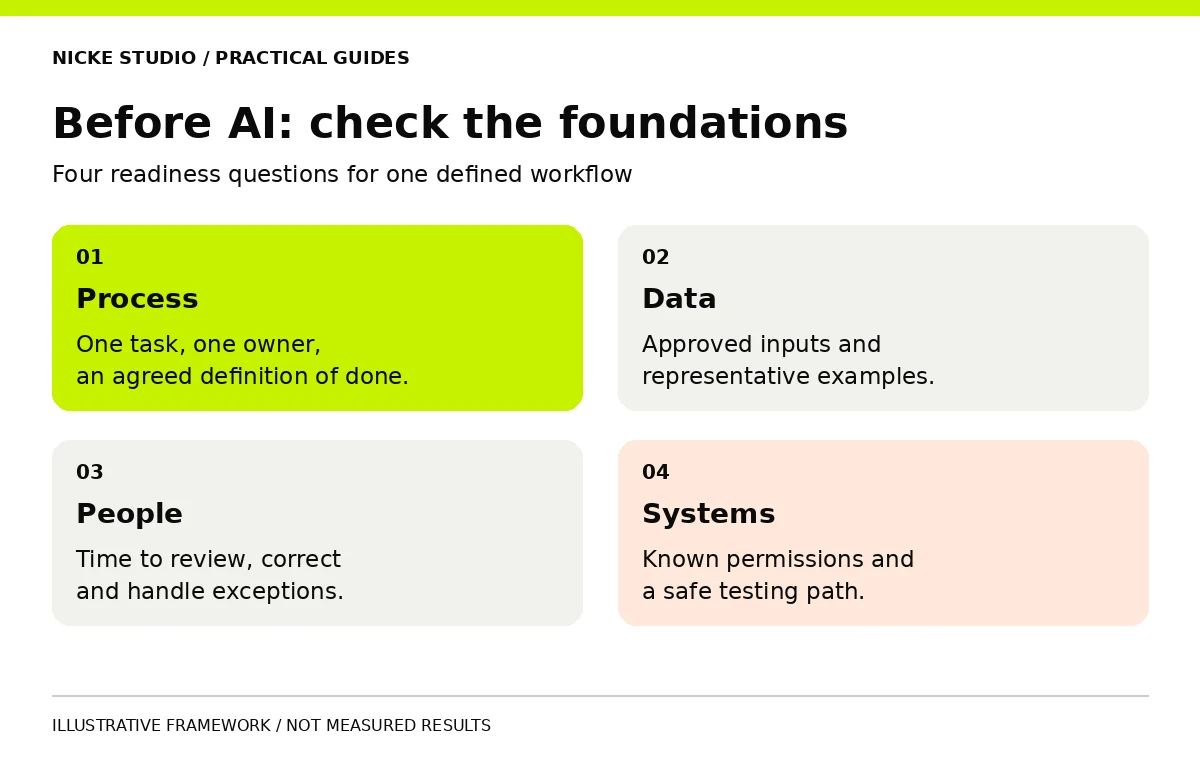
An AI readiness assessment checks whether a business has a sufficiently clear process, usable information, responsible people and workable systems to test an AI solution. Its purpose is to identify the next practical step. That step may be a pilot, a data cleanup or a simpler change to an existing tool.
You do not need a large transformation program to begin. You need a bounded question: can this team improve this task with the information and resources it actually has? This guide focuses on that decision, rather than choosing an agency or comparing model brands.
Begin with a task people can describe
Ask someone who performs the work to explain the last three cases they handled. Where did each request arrive? What information was missing? Which decision required judgment? Where was the result recorded? Observing real work often reveals dependencies that are absent from a process diagram.
A useful task statement is specific: prepare a draft reply to an incoming service inquiry using the current service catalogue. Improve customer experience is a goal, but it does not yet define something you can test.
Record the existing method before changing it. If employees follow different rules, agree on which rule the pilot will use. Automating an unsettled process can make disagreement happen faster without improving the outcome.
Check four areas of readiness
The following checklist is an editorial planning tool, not a certified maturity model. Do not turn it into a percentage that implies scientific precision. A serious blocker in one area may matter more than several positive answers elsewhere.
| Area | Evidence to collect | A reason to pause |
|---|---|---|
| Process | Examples, a task owner and an agreed definition of done | Nobody can decide whether an output is acceptable |
| Data | Approved inputs, representative cases and known gaps | Essential information is unavailable or cannot be used |
| People | A reviewer, operating capacity and a support contact | Review work has no owner or allocated time |
| Systems | A documented path between source and destination | Access, permissions or export capabilities are unknown |
For each area, write ready, needs preparation or blocked, followed by the evidence behind the judgment. This produces a useful discussion document without hiding uncertainty in an average score.
Data readiness means fitness for the task
A small, current collection of approved service descriptions can be more useful for a reply assistant than years of unfiltered company documents. Start with the information the task needs. Identify the authoritative source, who updates it and how the workflow detects outdated material.
- Check whether examples reflect current services and operating rules.
- Remove unnecessary personal or confidential information from early tests.
- Include difficult inputs, not only clean examples selected for a demonstration.
- Document missing fields, contradictions and information the system must not infer.
For example, if prices vary by an inspection, a model should not invent a quote because an older document contains a fixed price. The readiness question is whether that boundary is clear and testable. More documents do not automatically resolve conflicting instructions.
Google's People + AI Guidebook frames user needs and evaluation as connected design questions. Apply that idea by collecting examples that help you judge the actual task, rather than gathering data simply because it exists.
Check whether ordinary software is enough
AI may help when inputs vary and require interpretation. A fixed rule is usually easier to inspect when a task is deterministic. Copying an email address from one field to another does not require generative AI. Summarizing a long inquiry may benefit from it, with checks on what the summary omits.
| Need | A sensible first option | What to check |
|---|---|---|
| Route a request by a selected location | A form rule or CRM setting | Field validation and assignment |
| Interpret a free-text request | AI-assisted classification | Ambiguous cases and human correction |
| Send an approved acknowledgement | A template and trigger | Duplicate prevention and delivery |
| Draft a tailored reply | AI drafting with review | Unsupported claims and missing context |
Combining these approaches can reduce the amount of AI required. Keep predictable steps predictable, and test AI only where it may add value.
People and time are part of the infrastructure
A pilot needs a person who can judge outputs and someone who can fix operating problems. These may be different roles. Name both, then estimate the time they can spend on review, training and exception handling.
A process is not ready for automation when nobody has time to decide whether it worked.
Check how staff will report mistakes. A shared spreadsheet may be enough for an early experiment if it records the input, observed problem, expected result and resolution. Avoid feedback systems where employees can report dissatisfaction but cannot explain or correct the output.
Read the human in the loop AI guide when review design is the main unresolved issue.
Turn the assessment into a decision
End with a short action list, rather than a presentation that leaves every option open. Give each blocker an owner and a condition for resolving it. For instance: the operations lead approves the service catalogue; the CRM administrator verifies test access; a reviewer labels the first sample of cases.
- Choose one task and record its current performance.
- Gather representative examples and identify information gaps.
- Verify permissions and a safe testing environment.
- Assign review and support responsibilities.
- Decide whether to test, prepare first or stop the idea.
If preparation has no clear owner or affordable path, postponing the project can be a useful outcome. The assessment should make that visible before a larger commitment.
A practical example
Consider a hypothetical small service business that wants AI to draft replies. Its inquiry form is consistent, but the team has three versions of the service catalogue and no agreed policy for requests outside the coverage area. The first project is to approve one catalogue and document that exception. A drafting experiment can then test the approved rules.
This is a planning example, not a client case study. Its lesson is that readiness often depends on a few concrete decisions rather than buying another platform.
Questions teams ask before starting
Do we need perfectly clean data?
You need information fit for the task and a plan for known gaps. A pilot can test how incomplete inputs are handled, but it cannot establish accuracy when nobody can identify the correct answer.
Can a small business run an assessment?
Yes. A short review of one workflow, its examples and its owners can provide a useful first decision. Scale the assessment to the consequences and complexity of the task.
What happens after we are ready?
Move to a bounded AI proof of concept. If you need outside implementation help, use the broader AI agency selection guide to turn the findings into a comparable brief.
For help defining the first task, share your workflow with Nicke Studio.