

AI IMPLEMENTATION / NICKE STUDIO GUIDES
AI proof of concept: how to test an idea before scaling
Plan an AI proof of concept with a baseline, representative test cases and clear acceptance criteria. Learn what to measure before a pilot.
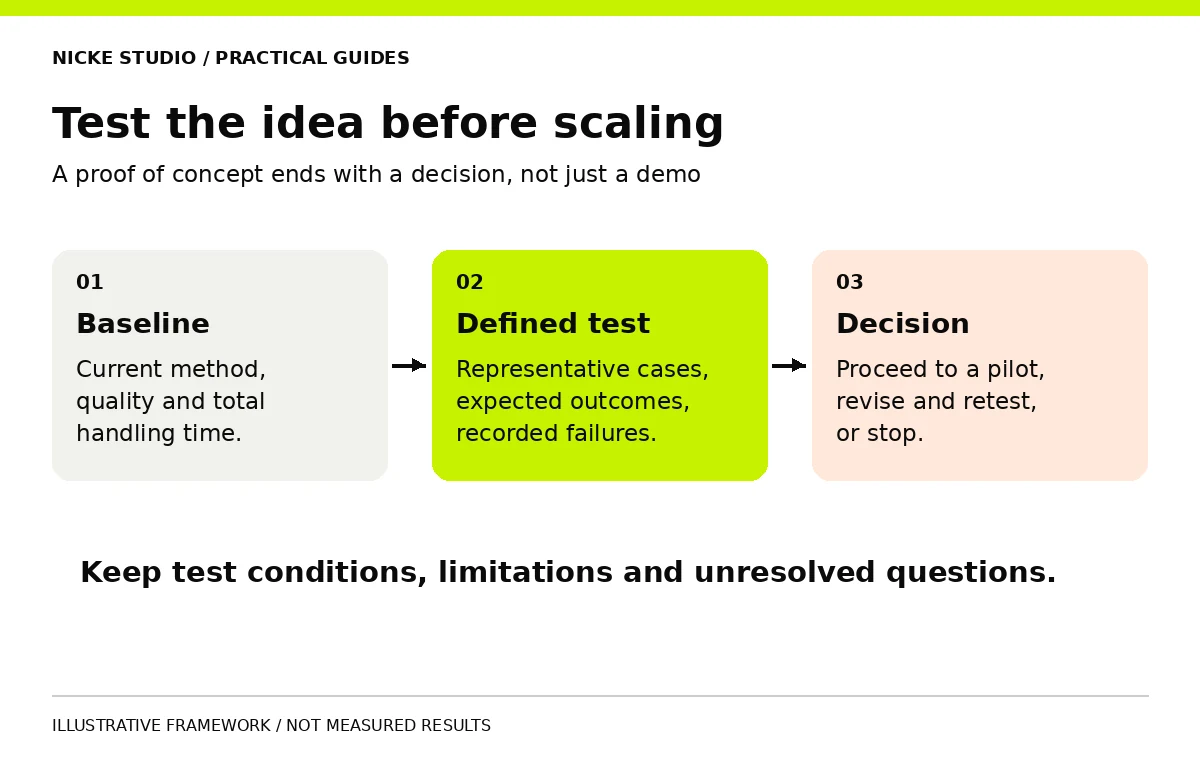
An AI proof of concept is a limited experiment designed to answer a feasibility question. It should establish whether a proposed approach can handle a defined task under stated conditions. A compelling demonstration is useful, but it is not enough to justify connecting the system to live business operations.
The central question is not whether a model can produce one impressive answer. It is whether the approach performs usefully across representative cases, at an acceptable operating cost, with failures your team understands.
Separate a demo, proof of concept and pilot
Teams sometimes use these terms interchangeably. Agree on their meaning before accepting a scope, because each stage answers a different question.
| Stage | Main question | Typical evidence |
|---|---|---|
| Demo | Can we understand the proposed experience? | A small set of selected examples |
| Proof of concept | Is the approach feasible for this task? | Recorded results on defined test cases |
| Pilot | Can a limited team operate it in practice? | Workflow performance, review effort and failures |
| Production | Can it be maintained as an ongoing service? | Monitoring, ownership, support and recovery procedures |
A proof of concept can use test data and a simplified interface. That is reasonable if the limitations are explicit. It should not be represented as production-ready merely because the interface looks finished.
Write one testable hypothesis
Replace broad ambitions with a task and comparison. For example: an AI assistant can draft service inquiry summaries that preserve the requested service, location and urgency, while reducing total preparation and review time compared with the current manual method.
This hypothesis includes quality and effort. It also defines what the system is doing: summarizing information, rather than approving requests or promising delivery dates. Those additional actions would require their own tests.
Before testing, complete the relevant parts of an AI readiness assessment. Missing reference material or unclear ownership can prevent a meaningful evaluation.
Build a test set that can reveal failure
Collect examples from the intended workflow, with permission to use them. Include routine cases, ambiguous messages, incomplete inputs and requests the system should decline or refer to a person. Document why each case matters.
Separate development examples from evaluation examples. If you repeatedly adjust instructions to fit the same cases, those cases become less useful as evidence of performance on unfamiliar inputs. Preserve an untouched set for the final comparison where practical.
- Record the expected result or evaluation criteria before reviewing the AI output.
- Include cases that expose costly mistakes, even when those cases are uncommon.
- Keep case identifiers so results can be reproduced without exposing unnecessary data.
- Note gaps in the sample: one week of inquiries may not represent seasonal work.
There is no universal sample size that makes every AI experiment reliable. Choose coverage according to task variety and the consequences of failure, and state what the sample cannot establish.
Define acceptance criteria before the demonstration
Use criteria that a reviewer can apply consistently. Instead of good quality, specify whether the requested service is preserved, whether unsupported claims appear and whether missing information is flagged.
| Measure | How to record it | Why it matters |
|---|---|---|
| Required details preserved | Reviewer checks each required field | A fluent summary can still omit essential facts |
| Unsupported claims | Count and classify invented details | Some errors carry more consequences than others |
| Total handling time | Preparation plus review and corrections | Generation speed alone can exaggerate benefit |
| Escalation behavior | Check cases requiring a person | A useful system must recognize operating boundaries |
| Cost per accepted result | Test operating cost divided by accepted outputs | Rejected outputs still consume resources |
Set thresholds appropriate to your workflow. A critical failure can justify stopping even when the average score looks positive. The table is a planning framework, not a universal benchmark.
Compare against a realistic baseline
Run the current method on comparable cases. If the existing process uses templates, include those templates in the baseline. Comparing a polished AI workflow with an unnecessarily slow manual process makes the result less useful.
Record who performed the work and how timing was measured. Where feasible, avoid telling reviewers which method produced each output. Preserve the evaluation notes so another person can understand why a case passed or failed.
Google's Data Collection + Evaluation guide connects evaluation to the user need and success measures established for the product. For your experiment, this means judging the business task rather than selecting a convenient model score.
Keep a record of the experiment
Save the input set, reference material, instructions, model identifier where available, relevant settings, integration version and evaluation date. Repeat a sample to look for output variation. Do not imply that one run proves the workflow will behave identically every time.
Also record failures outside the model: missing documents, a timeout, a malformed response or a reviewer who lacked the information to make a decision. These can be as important as the quality of the generated text.
A useful experiment can end with a decision to stop. Its value is reducing uncertainty before a larger commitment.
Decide what happens next
Use three possible outcomes: proceed to a limited pilot, revise and retest, or stop. Write the evidence behind the decision and the unresolved questions. A pilot still needs permissions, support and recovery procedures that a proof of concept may not have included.
A hypothetical summary experiment might show acceptable factual coverage but no time saving because corrections take too long. The next step could be a narrower structured extraction task, rather than scaling the same approach. This example illustrates a decision pattern; it does not report measured client results.
Common questions
How long should a proof of concept take?
Long enough to answer the defined question with usable evidence. Duration depends on access, task variety and review capacity. Agree on a boundary and a decision date instead of letting the experiment expand into an indefinite build.
Should the proof of concept connect to live systems?
Only when the connection is necessary for the question and its effects are controlled. Many feasibility questions can be tested with approved sample data before write access is introduced.
What should we receive at the end?
A concise report containing the hypothesis, baseline, test coverage, results, costs, limitations and recommendation. Keep the test cases for later regression checks and provider portability tests.
Next, design human review and an AI integration strategy for the pilot. Contact Nicke Studio if you need help turning an idea into a defined experiment.