
AI STRATEGY / NICKE STUDIO GUIDES
AI vendor lock-in: how to keep your workflows portable
Reduce AI vendor lock-in by documenting accounts, exports, prompts and integrations. Test a practical exit path before a platform becomes critical.
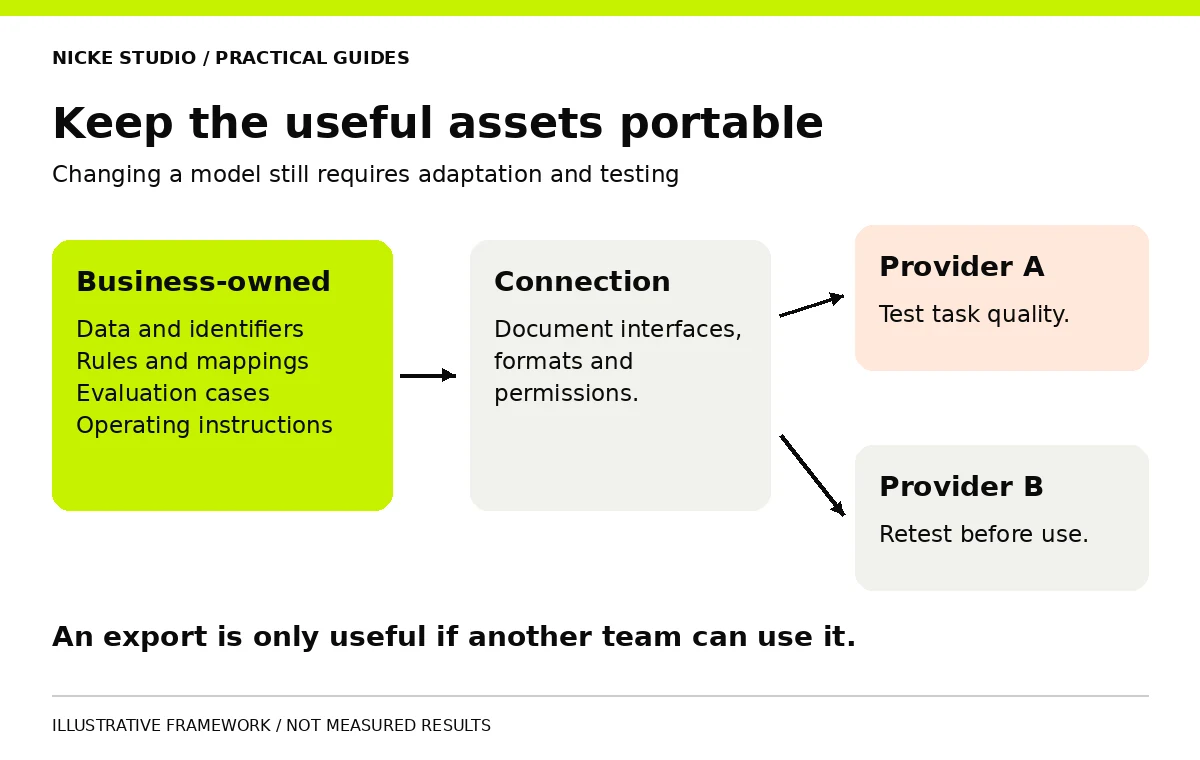
AI vendor lock-in happens when changing a provider becomes difficult because important data, configurations, operating knowledge or integrations depend on that provider. The issue is not simply whether a platform uses proprietary software. It is whether your business has a workable replacement path if the relationship, product or economics change.
Some dependency is a reasonable tradeoff. A managed platform may reduce setup work and provide features your team would struggle to operate. The goal is to understand the dependency, keep essential assets under control and test the parts that would matter during a change.
Find the dependency before choosing a solution
Break the workflow into assets and services. Your customer data, field mappings and evaluation cases are different from a provider's model or hosted runtime. Each has a different ownership and migration question.
| Layer | Portability question | Useful evidence |
|---|---|---|
| Accounts and billing | Who controls the business account? | An authorized internal owner and recovery path |
| Business data | Can records and attachments be exported? | A usable sample export with identifiers |
| Instructions and rules | Can another team understand the workflow? | Versioned instructions and decision rules |
| Integrations | How much provider-specific logic exists? | Field mappings, interface contracts and dependencies |
| Quality evaluation | Can a replacement be tested fairly? | Representative cases and expected outcomes |
Keep this inventory short enough to maintain. A spreadsheet with an owner and verified export date for each critical asset can be more useful than a large document nobody updates.
Keep business-owned accounts recoverable
Where the arrangement calls for business ownership, create or retain accounts under the business's control and grant suppliers the access required for their work. Document who can change billing, recover access and remove a former collaborator.
Clarify what is delivered when a contract ends. Access to a live interface is different from receiving the underlying configuration, source files or exportable workflow. Record the agreed deliverables explicitly rather than assuming every asset belongs to the buyer.
This is an operational planning checklist, not an interpretation of a particular contract. Resolve ownership terms with the supplier before the dependency becomes critical.
An export is useful only if it can be used
Download a small approved sample and inspect it. Can another tool read the format? Are attachments included? Do exported records preserve identifiers, relationships, timestamps and the context needed to interpret them? A file that opens successfully may still omit important information.
- Check whether an export contains the complete record or only visible fields.
- Verify relationships between contacts, requests and associated files.
- Record the steps and permissions needed to create the export.
- Test how an authorized person would restore or import the data elsewhere.
Keep sensitive exports in an approved location with suitable access. Creating portability should not mean distributing unnecessary copies of business data.
Separate business rules from provider behavior
A rule such as requests outside the coverage area require review should remain understandable without access to one model's chat history. Store the policy, allowed categories and field mappings in maintained documentation or configuration.
Model-specific instructions may still be necessary. Different providers can interpret prompts, tool calls and structured output requests differently. Treat the provider connection as an adaptable component rather than assuming the same prompt will behave identically everywhere.
The OpenAPI Specification standardizes descriptions of HTTP APIs. Such interface documentation can help a replacement team understand a connection, but it does not guarantee equivalent AI behavior or automatic migration.
Preserve the tests that define acceptable quality
Without evaluation cases, a migration can become a subjective comparison of a few attractive outputs. Keep representative inputs, evaluation criteria and known failure cases from the original AI proof of concept.
Run a candidate replacement on the same task and inspect accuracy, review effort, latency and operating cost. Record differences that affect the workflow. A lower model price may offer little benefit if reviewers need substantially more time to correct the results.
Portability means being able to verify a replacement, not merely being able to select a different model name.
Include the surrounding integration in the test. A provider switch can affect response formats, error handling and timing even when the generated text remains acceptable.
Test a small exit path early
A practical exit rehearsal does not require migrating the full business. Choose one approved test record and one noncritical workflow. Export the required data, recreate the configuration in a controlled environment and compare the outcome against the expected result.
- Select a bounded workflow and document its current dependencies.
- Export a usable sample and verify what it contains.
- Recreate the business rules outside the original platform.
- Run the preserved evaluation cases on a candidate replacement.
- Estimate migration effort, operating differences and unresolved gaps.
- Record the decision and the next date or trigger for reassessment.
This reveals where the actual switching cost sits. It may be in an undocumented integration or missing attachment export rather than the model itself.
Balance flexibility with operating complexity
Supporting several providers from day one adds development and testing work. A small business may reasonably choose one platform and maintain a documented fallback instead. More layers do not automatically produce a more reliable system.
| Approach | Potential benefit | Cost to consider |
|---|---|---|
| One managed platform | Simpler operations and support | Greater dependency on its capabilities and exports |
| Documented replacement path | Lower ongoing complexity with a prepared exit | Migration still requires execution and validation |
| Multiple active providers | More immediate options for selected tasks | More configuration, evaluation and failure modes |
Choose according to how critical the workflow is, the consequence of downtime and the team's operating capacity. Avoid building an abstraction layer that costs more to maintain than the dependency it is intended to reduce.
A realistic planning example
Imagine a hypothetical business using one provider to draft inquiry summaries. It keeps customer records in its own CRM, maintains service rules separately and retains a representative evaluation set. If the provider changes, the team still needs to adapt the connection and retest quality, but it does not need to reconstruct the entire process from a chat history.
This is an illustrative architecture, not evidence of a measured migration outcome. Its value is showing which assets remain useful across a change.
Frequently asked questions
Does open source remove lock-in?
Not automatically. Open-source software can still depend on specialized hosting, custom integrations and knowledge held by one person. Inspect exportability, documentation and operating skills as well as licensing.
Should we switch providers whenever prices change?
Compare total migration and operating effort with the expected benefit. Include testing, support, review time and the risk of disruption. A small price difference alone may not justify a change.
What is the first practical step?
Identify the account owner and test one usable export. Then document the workflow's rules and keep its evaluation cases. These steps improve continuity even if you never migrate.
Read the AI integration strategy guide for connection design, or use the AI agency guide to include portability in a supplier brief. Talk to Nicke Studio about a defined handover and operating plan.